@takk/caduceus - v1.0.0 - Apache-2.0

One shape for every model. One transport you can see.

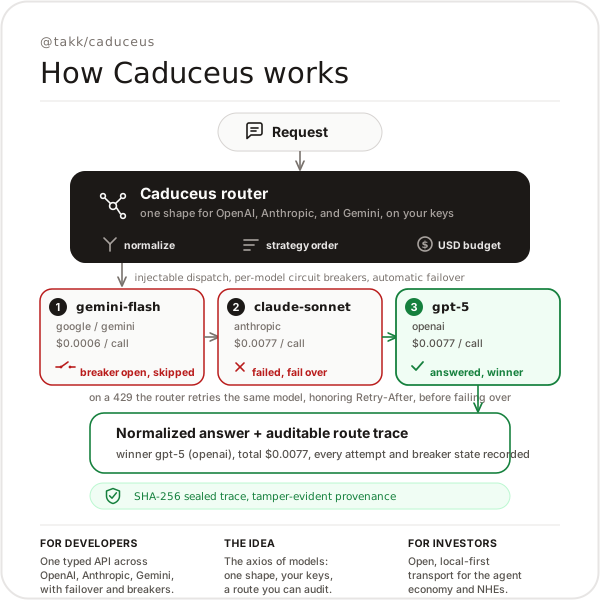
Every provider has a different request, stream, and tool-call format; a closed gateway hides which model answered, prices at the ceiling, and blocks the EU. Caduceus runs in your process with your keys, normalizes OpenAI, Anthropic, and Gemini, and routes by cost, quality, or latency with failover, hard USD budgets, and an auditable trace. It is Massive Intelligence (IM) infrastructure for non-human entities (MAIC, HIMs, NHEs), the transport for automation beyond OpenClaw, Hermes Agent, and Claude Code.

159tests passing
94%coverage
0runtime deps
11subpaths
What it is

One library, every provider in one shape.

In a few words

Caduceus gives every provider a single shape. You register a pool of providers and models and inject your own dispatch, and it normalizes OpenAI, Anthropic, and Gemini, orders the candidates by a strategy, and tries them with failover, returning the answer plus the winning model, the cost, and the full trace. Your code is two lines: new Caduceus({ dispatch, providers, models }), then caduceus.complete(request).

Technically

A strategy orders the candidate models by cost, quality, or latency. Each request is encoded to the provider's wire shape, dispatched through the injectable transport, and decoded back to one vocabulary. A budget tracker forecasts each call and refuses any that would breach the ceiling, a per-model circuit breaker trips a failing provider open and the router fails over to the next, and every attempt is recorded in an auditable route trace sealed with SHA-256. The core never speaks a provider API.

Before and after

The same task, two very different deals.

Take a real production scene: a request you want to send to the best available model, with automatic failover when one provider is down, a hard cost ceiling, and the routing visible.

Hand-wiring or a closed endpoint

Glue code per provider, or one opaque gateway you cannot see into

  1. Glue code You hand-wire each provider's request, stream, and tool format, rewritten on every swap.
  2. Closed gateway You cannot see which model answered or audit the path it took.
  3. Cost Pricing sits at the ceiling of the pool, and stacked calls surprise you on the invoice.
  4. Resilience When a provider is down, your request goes down with it; failover is yours to build.
  5. Sovereignty A vendor sits in the middle of every call, and the EU and EEA may be blocked.
  6. Lock-in The routing and the keys belong to someone else.
  7. Result Either brittle glue you own or a black box you do not, with no middle ground.
With Caduceus

Open transport, the router shows you exactly which model answered and why

  1. Normalize One typed vocabulary for OpenAI, Anthropic, and Gemini requests, streams, and tools.
  2. Route Seven strategies order your pool by cost, quality, or latency, your choice per request.
  3. Cost Each candidate is forecast and a hard USD ceiling is enforced before any call.
  4. Resilience Per-model circuit breakers trip a failing provider open and the router fails over.
  5. Sovereignty It runs in your process, on your infrastructure, with your keys, EU included.
  6. Transparency Every request is an auditable route trace, with per-attempt cost and the winner named.
  7. The trace seals with SHA-256, verifiable, for the compliance review.

Open transport is the middle ground between brittle per-provider glue and an opaque closed gateway; it keeps the normalization, the routing, and the cost in your hands, on your infrastructure, with every attempt exposed as an auditable trace.

Install

Five minutes from install to your first auditable run.

1. Add the package

pnpm add @takk/caduceus
npm install @takk/caduceus
yarn add @takk/caduceus
bun add @takk/caduceus

2. Zero required dependencies

The core has no runtime dependencies and a node-free core. Every @takk sibling is an optional peer; install only what you compose with.

# nothing else is required to start experimenting
              # optional: install a sibling you compose with, for example
              pnpm add @takk/keymesh @takk/modelchain

3. Route a request in a few lines

import { Caduceus, defineProvider, defineModel } from '@takk/caduceus';
              import { createEchoDispatch } from '@takk/caduceus/codec';

              const providers = [
              defineProvider({ id: 'openai', shape: 'openai' }),
              defineProvider({ id: 'google', shape: 'gemini' }),
              ];
              const models = [
              defineModel({ id: 'gpt', provider: 'openai', model: 'gpt-5', cost: { inputPerMTok: 5, outputPerMTok: 15 } }),
              defineModel({ id: 'flash', provider: 'google', model: 'gemini-flash', cost: { inputPerMTok: 0.3, outputPerMTok: 1.2 } }),
              ];

              // Inject your dispatch; createEchoDispatch is a deterministic offline stand-in.
              const caduceus = new Caduceus({ dispatch: createEchoDispatch(), providers, models, strategy: 'cost-first' });
              const result = await caduceus.complete({ messages: [{ role: 'user', content: 'Draft a migration plan.' }] });

              result.winner;       // which model answered, after any failover
              result.totalCostUsd; // total USD for the route
              result.attempts;     // the auditable route trace

4. Expose it as a tool a non-human entity can call

import { createTransportTool } from '@takk/caduceus/adapter';

              // A framework-agnostic descriptor (name, description, JSON Schema, handler) that
              // matches what MCP servers and tool-calling APIs expect. Its name is 'caduceus_route'.
              const tool = createTransportTool(caduceus);
              const result = await tool.handler({
              messages: [{ role: 'user', content: 'Audit the dependency tree for advisories.' }],
              strategy: 'quality-first',
              });
              // the host fixes the model pool; the caller only sends a request
Features

Nine capabilities, every one tied to a measurable outcome.

One shape for every provider

The codec normalizes the request, response, streaming, and tool-call formats of OpenAI, Anthropic, and Gemini into one typed vocabulary, with an OpenAI-compatible shape for any other gateway.

Write against one API; swap or add a provider without touching your call sites.

Seven routing strategies

Cost-then-quality, cost-first, quality-first, latency-first, weighted, round-robin, and sequential cascade order your pool; the router tries them in order, skipping open breakers and failing over on error.

Pick the trade the request deserves, instead of trusting one opaque router.

Breakers, failover, and rate-limit recovery

A per-model breaker trips a failing provider open and the router fails over; on a 429 it first honors Retry-After (or a capped backoff) and retries the same model, optionally with a rotated key, before failing over.

A provider going down or rate-limiting you does not take your request with it.

Local-first sovereignty

The routing runs in your process, on your infrastructure, with your keys. The core never speaks a provider API; no vendor sits in the middle of every call, and the EU and EEA are not blocked.

Route to frontier models where a closed, region-locked gateway cannot follow you.

Explicit cost budgets

Each model carries a cost profile. The router forecasts the dollar cost of each candidate before any call and enforces a hard ceiling, raising a typed BUDGET_EXCEEDED before a breaching call.

Cost is a number you set up front, instead of a surprise at the ceiling of a vendor pool.

Normalized streaming

OpenAI chunk deltas, Anthropic content-block events, and Gemini partial candidates arrive as one typed StreamEvent union, with tool-call deltas reassembled the same way across every provider.

Consume any provider's stream through one switch, instead of a parser per vendor.

Auditable route trace

Every request records which models were tried, each breaker's state, each attempt's cost and latency, and the winner. It renders to DOT or Mermaid and seals with SHA-256 via the Web Crypto API.

Prove which model answered, in Node, edge runtimes, or the browser, when a route is questioned.

Drop-in adapters

Two-line bridges wrap a Vercel AI SDK call or an OpenAI-style chat function as the dispatch, expose the router as an MCP-ready tool, and feed the @takk/coryphaeus orchestrator's agent pool.

Adopt it next to what you already run, instead of rewriting your stack.

SLSA provenance

Every published version signed with npm publish --provenance through GitHub Actions OIDC. Lockfile committed, zero required runtime dependencies, node-free core.

Verify in one command that the tarball you installed was built from the source commit you trust.

Routing

Seven strategies, no black box.

A strategy orders the candidate models per request, and you pick which one. The router then tries them in order, skipping open breakers and failing over on error. The only knobs are the breaker tuning and the budget.

Strategy Orders by Use it when
cost-then-quality Cheapest first, ties broken by higher quality. The default; you want the cheapest acceptable model.
cost-first / quality-first Strictly cheapest, or strictly highest quality. Cost or quality is the single thing that matters.
latency-first Lowest latency hint first. Responsiveness matters more than cost.
weighted / round-robin Highest selection weight, or a rotating start each request. You want to spread load across the pool.
sequential-cascade Cheapest-and-weakest first, escalating to stronger models. You expect to try several and escalate on failure.

The 1.0 strategies are transparent and deterministic; a quality-measured strategy (evaluators and bandits) is a later release behind the same Strategy seam.

Entry points

Eleven subpaths, import only what you need.

Entry point Subpath export Runtime Use it when
Toolkit barrel @takk/caduceus node-free You want the router, the codec, the strategies, breakers, budget, the trace, and the adapters.
Transport @takk/caduceus/transport node-free You want the Caduceus router on its own to plan, complete, and stream.
Adapters and tool @takk/caduceus/adapter node-free You want the Vercel or OpenAI dispatch bridge, the @takk/coryphaeus AgentClient, or the routing tool for MCP.
Node entry @takk/caduceus/node Node only You need the real fetch dispatch, or to load a provider roster, a request, or a saved trace from JSON.
CLI

A command-line tool that runs the real router.

The caduceus binary runs the compiled engine. providers lists the pool; plan shows the strategy ordering and a cost forecast; route routes a request offline with the deterministic echo dispatch behind --mock; trace renders a saved trace to DOT or Mermaid. Real provider routing uses the library API with the Node fetch dispatch.

Plan a route and forecast its cost

# show the strategy ordering and a cost forecast, no network
              npx @takk/caduceus plan request.json --providers providers.json --models models.json

Route offline, then render the trace

# route with the deterministic echo dispatch and save the trace
              npx @takk/caduceus route request.json --providers providers.json --models models.json --mock --out trace.json
              npx @takk/caduceus trace trace.json --format mermaid
          

List the pool, inspect version and help

npx @takk/caduceus providers --providers providers.json --models models.json
              npx @takk/caduceus --version

              # exit codes: 0 ok, 2 usage or input, 21 no route, 30 budget exceeded
Audit and transparency

Prove which model answered, and read the whole route.

Seal every route into a tamper-evident SHA-256 digest. And because each route is explicit, complete returns the answer, the winning model, the per-attempt cost, and every attempt the router made, so the routing is never a black box. Both are node-free and need no external service.

import { sealTrace, verifyTraceSeal, renderTraceDot } from '@takk/caduceus/trace';

              const result = await caduceus.complete({ messages: [{ role: 'user', content: 'Triage the alert.' }] });

              const seal = await sealTrace(result); // a SHA-256 integrity seal over the route trace
              await verifyTraceSeal(result, seal); // true, until any field of the trace is altered
              renderTraceDot(result); // a Graphviz transport graph of every attempt

Every route is explicit

const result = await caduceus.complete({ messages: [{ role: 'user', content: 'Summarize the incident.' }] });
              // {
              //   request: 'req_1',
              //   strategy: 'cost-then-quality',
              //   response: { text: '...', toolCalls: [], finishReason: 'stop', usage: {...} },
              //   winner: { model: 'gpt', provider: 'openai' },   // which model answered
              //   attempts: [ ... ],                              // the auditable route trace
              //   totalCostUsd: 0.0031
              // }

The result carries the strategy used, the per-attempt cost, and the winner, so you can see which model answered and what the route cost. Seal each trace with no runtime dependency, the governance seam for a non-human entity routing across a pool of models it operates.

Compare

Caduceus vs the alternatives.

The other approaches solve part of the problem. The contrast clarifies where Caduceus sits.

Capability Caduceus Closed endpoint Agent framework Vercel AI SDK Hand-rolled
Distribution npm library hosted endpoint npm library npm library your repo
Transparent routing auditable trace black box hand-wired thin primitives varies
Failover & breakers per-model hidden manual basic manual
Cost forecast and ceiling yes pool ceiling manual no varies
Provider-agnostic injectable pool fixed yes yes varies
Local-first sovereignty your infra region-locked yes yes yes
Auditable trace yes no no no no
Zero deps, node-free yes n/a deps deps varies
License Apache-2.0 proprietary mixed Apache-2.0 your call

The honest summary: a closed gateway is fine when you do not need to see inside, and a single direct call is fine when one provider always answers. Pick Caduceus when you want a single shape over many providers, with automatic failover, the routing and cost visible, sovereignty over where it runs, and a tamper-evident trace, all in one node-free TypeScript library you embed in production.

The transport, honestly

What the transport assumes, and how it stays honest.

Caduceus is transparent routing over an injectable dispatch, and that has boundaries. They are documented, and where reality bends them, there is an explicit choice rather than a silent fudge.

Assumption or property What it means How Caduceus handles it
Deterministic strategies The 1.0 strategies order candidates by transparent rules, not a learned router. The ordering is a pure function of cost, quality, and latency; a measured strategy is a documented later release behind the same seam.
Injectable dispatch The core never speaks a provider API; the answer quality is the dispatch's and the providers'. You provide the transport; Caduceus routes and audits it, and tests run against a deterministic echo dispatch.
Single-answer routing A route returns the first model that answers, not a composition of several. Composing several models into one answer is the job of the @takk/coryphaeus orchestrator, which Caduceus feeds.
Cost is forecast then measured The pre-dispatch forecast uses a chars-per-token heuristic. Actual cost is recomputed from the response's reported token counts and recorded per attempt; the forecast only gates dispatch.
Failover on error The router fails over when a dispatch throws or returns an HTTP error status. A successful but low-quality answer is not a failure; quality-based rejection is a measured-strategy concern, documented for later.
Budget is a hard ceiling The ceiling is enforced before a breaching call is dispatched. It raises a typed BUDGET_EXCEEDED rather than reporting an overrun after the fact.
Provenance from the trace Provenance is which model answered. It is read off the recorded attempts, the winning model, not asserted by the model.
Integrity, not identity The trace seal proves a trace was not altered after sealing. A SHA-256 digest via Web Crypto, an integrity seal, not a signature.
Quality and validation

The receipts behind v1.0.0.

Tests & coverage

159 tests passing under Vitest 4 with 94% coverage, across 13 suites on the Node 20, 22, and 24 matrix. Five runnable examples and a transport benchmark route against the built artifact end to end. Run pnpm test on a fresh clone to reproduce.

Type safety

TypeScript 6 in maximum strict mode (exactOptionalPropertyTypes, useUnknownInCatchVariables, noUncheckedIndexedAccess, noImplicitOverride, noImplicitReturns). Zero errors under tsc --noEmit.

Lint & types-correctness

Biome 2.5 clean across src and tests. publint clean and @arethetypeswrong/cli green across all eleven subpaths. Dual ESM + CJS with separate .d.ts and .d.cts per subpath.

Behavior, verified

Each strategy orders the pool as documented, the budget guard trips before a breaching call, an open breaker is skipped and the router fails over to the next candidate, and the trace seal detects a tampered field. Every invariant is a test.

Distribution smoke

A smoke test exercises the compiled ESM and CJS artifacts and spawns the compiled CLI as a single Node process, run on the Node 20, 22, and 24 matrix.

Supply chain

Committed pnpm lockfile, zero required runtime dependencies, node-free core, and SLSA provenance attestation on every published version. Verify with npm view @takk/caduceus@1.0.0 --json | jq .dist.attestations.

Roadmap

What is shipped, what is next, what is later.

Now (1.0)

Shipped in v1.0.0

  • Codec normalizing OpenAI, Anthropic, and Gemini
  • Seven routing strategies with automatic failover
  • Per-model circuit breakers, rate-limit recovery, and hard USD budgets
  • Auditable route trace, JSON, DOT, and Mermaid renders
  • Vercel and OpenAI dispatch bridges, @takk/coryphaeus AgentClient, routing tool
  • Fetch dispatch with SSE, CLI with providers, plan, route, trace
  • Dual ESM + CJS, node-free core, SLSA provenance
Next

Planned next

  • Quality-measured strategy with evaluators and bandits
  • More provider shapes and a live compatibility test suite
  • Managed key pools and quotas via @takk/keymesh
  • Hosted routing analytics and provider profiles
  • Signed and timestamped trace seals
Later

On the horizon

  • Region-aware sovereignty profiles for routing
  • An optional hosted gateway and provider registry
  • A runnable MCP server binary
  • Edge-native routing analytics dashboards
FAQ

Common questions.

Is Caduceus production-ready at 1.0.0?

Yes. 159 tests pass under Vitest 4 with 94% coverage; TypeScript 6 maximum strict mode is clean; Biome 2.5 lint is clean; publint and @arethetypeswrong/cli are clean across all eleven subpaths. The suite and the distribution smoke test are run on the Node 20, 22, and 24 matrix. Every published release carries SLSA provenance produced by GitHub Actions.

Why not just call one provider directly?

Because no single provider is always up, always cheapest, or always best; different providers lead on programming, mathematics, security, and long context, and any of them can rate-limit or go down. Caduceus routes to the best available model by your strategy and fails over automatically when one is down, so a single hard-coded provider is never a single point of failure.

Why not write your own provider glue?

You can, and many do. The cost is per-provider request, stream, and tool-call code that you rewrite on every swap, and failover, breakers, budgets, and a trace you must build yourself. Caduceus normalizes the shapes, orders the pool by a strategy, and builds the cost forecast, the budget ceiling, the circuit breakers, and the auditable trace in, so the transport is one library instead of glue per provider.

Does Caduceus call any model itself?

No. The core is routing logic over an injectable dispatch. You provide the transport, the bundled fetch dispatch, a Vercel AI SDK call, an OpenAI-style chat function, or a deterministic mock, and the router drives it. That keeps the package provider-agnostic, dependency-free, and testable with no network, and it means your provider keys live in your dispatch, never in Caduceus.

Does this work in Cloudflare Workers, Vercel Edge, Bun, or Deno?

Yes. The core is node-free; the trace seal uses the Web Crypto API, not node:crypto. Import @takk/caduceus or @takk/caduceus/edge on any runtime with Web Crypto, and pair it with a dispatch built on the runtime's own fetch. Only @takk/caduceus/node, the bundled fetch dispatch and the JSON loaders, requires the Node standard library.

How does Caduceus handle my data?

Caduceus holds the provider and model descriptors you register, the request you pass, and the route results it builds, nothing else. It makes no outbound network calls of its own; the only model calls are the ones your injected dispatch makes to your chosen providers. With the file loaders, only the roster, request, or trace files you point it at are read from disk, and no provider credentials are ever held by Caduceus.

What does the routing strategy actually decide?

Per request, the strategy orders the candidate models by cost, quality, or latency; the router then tries them in that order, skipping models whose circuit breaker is open and failing over on error. The 1.0 strategies are transparent and deterministic. You can pick a strategy per request, restrict the candidate models, or read the recorded attempts to see exactly which models were tried and why one won.

Is the trace seal a digital signature?

No, and the docs are explicit about it. The seal is a SHA-256 digest of the trace's canonical form, so any later edit makes verifyTraceSeal return false. It is an integrity seal, not a signature: it does not prove who produced the trace. Signed and timestamped seals for stronger third-party evidence are on the roadmap.

Which providers does it support?

The codec normalizes OpenAI, Anthropic, and Gemini natively, and an OpenAI-compatible shape covers any other gateway (Ollama, vLLM, Together, Groq, OpenRouter, and the rest). Because you inject the dispatch, you can also route to a local model or a mock. Adapters are included for an OpenAI-style chat function and the Vercel AI SDK, so wrapping your existing call is two lines.

Where does the state live?

In-process memory by default: the registered provider and model pool and the per-model circuit-breaker counters. For disk-backed input, load a provider roster, a model roster, a request, or a saved trace from JSON with @takk/caduceus/node. A route trace is a plain object you can serialize to your own store whenever you want.

How does it keep cost under control?

Each model carries a cost profile. Caduceus forecasts the dollar cost of each candidate before any call, and a budget tracker refuses any call that would breach the per-request ceiling you set, raising a typed BUDGET_EXCEEDED. A cost-first or sequential-cascade strategy further tries the cheapest model first and escalates only on failure.

How do I verify a published version's provenance?

Every release is published with npm publish --provenance. Check the attestations with npm view @takk/caduceus@<version> --json | jq .dist.attestations. The attestation links the tarball you installed to the GitHub Actions workflow that built it from a specific source commit.

What is the policy on breaking changes?

Strict SemVer 2.0.0, starting from 1.0.0. The binding stability surface is documented in SPEC.md section 5. Major bumps require a deprecation cycle; security fixes follow the disclosure flow in SECURITY.md.
Author

Built and maintained by David C Cavalcante.

David C Cavalcante

Founder, Takk Innovate Studio

Product Engineer, ML Engineer, LLM Engineer, LLM Architect, Massive Intelligence (IM) Researcher. Builder of the @takk family of NPM packages for Massive Intelligence (IM) native infrastructure.

Caduceus is part of a planned portfolio of NPM libraries targeting Massive Intelligence (IM) native infrastructure for 2026 to 2030. Adjacent research by the author covers systemic intelligence frameworks (MAIC, HIM, NHE) published independently of this codebase, with research notes on PhilPapers and PhilArchive linked from the repository README.

If Caduceus composed a frontier-model team under control for you this quarter, the most useful thing you can do is open a GitHub issue when you find an edge case the test suite missed. The runbook for releases, the threat model, and the contributor agreement all live in the repository.